
Red River
Howard Hawks's classic Western is immense in the epic dimensions of its tale and explosive in the raw and hotly charged battle of wills that runs through it.

Grade: A
This would be Howard Hawks’s best film, if he hadn’t made The Big Sleep. Nothing’s better than a Bogart and Bacall film – nothing. It may also be the best Western ever, better even than The Man Who Shot Liberty Valance and The Wild Bunch. That’s just a maybe. It depends on what you’re in the mood for. Red River isn’t a historical saga like Liberty and it doesn’t have The Bunch’s explosive daring. It’s much more quietly personal, but at the same time immense in the epic dimensions of its tale and explosive in the raw and hotly charged battle of wills that runs through it.
John Wayne stars as Texan rancher Tom Dunson. Dunson’s spent fourteen years growing his herd from one cow and one bull to a hard of 10,000 cattle and now he’s going to drive them to Missouri to sell them. He warns his men that they’ll meet bad weather, bad country, Native Americans and bandits. “It’s gonna be a fight all the way,” he addresses them while they’re all packed inside his homestead, looking like troops assembled in a bunker listening to their commander gradually march to the stage in his speech when he booms the order to go over the top. Wayne’s characteristic thundering delivery gives the drive all the rhythm of a Homeric task. Except Dunson’s broke, so he doesn’t have any choice but to go and his men follow him.
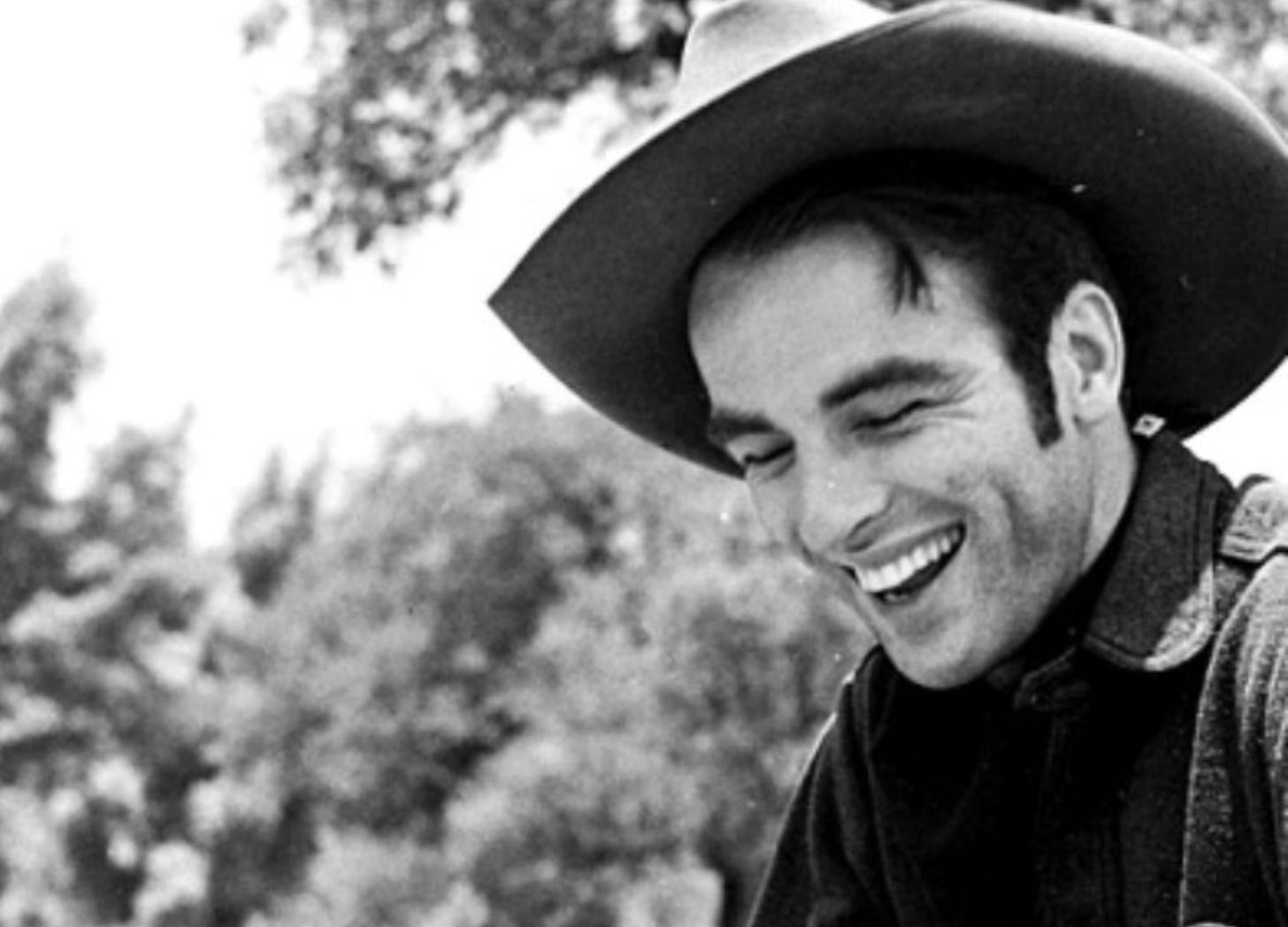
Amongst them is the film’s second star Montgomery Clift playing Dunson’s adopted son Matthew Garth. Matt’s just as determined to get the cattle to market as Dunson but he finds it harder and harder to stand by and watch Dunson’s increasing cruelty to the men as the drive goes on. Dunson starts by denying the men rest for the sake of making it farther, but he escalates to killing those who try to quit. “If you ain’t crazy, you’re skin-close to it,” one cattle hand tells Dunson. “I signed a pledge [to finish the drive] sure, but you ain’t the man I signed it with.”
In typical Hawksian fashion, beneath the film’s immediate and dramatic physical conflict is an equally, if not more so, dramatic personal conflict but one not seen in Hawks’s other films: a conflict between a father and son. Except this one could end in a gunfight. This is a Western after all.
Dunstan, Matt and their crew of cattle-hands are your childhood dreams of heroic cowboys. They’re men bent on a goal and nothing can stop them no matter how hard they hear it’ll be. Once they set out, they ride every mile carrying their own straight-forward code of honour that means they won’t ever shoot a man without a gun on his hip, and not without giving him a chance to draw, and once they’ve given their word they won’t go back on it.
Wayne, of course, epitomises this ideal as the rugged individualist writ large across the screen. In the film’s first few scenes, he sets out on his own to start his own ranch. Nothing stops him. Not his boss’s warnings about the danger. Not even the pleas of the woman he loves. He tells her he’s made up his mind not to take her with him. “Just change your mind Tom for once in your life,” she begs him. Of course he doesn’t. He’s the man who stays the course once he’s set it no matter what. Years later when he’s driving his cattle to Missouri, Dunson strides through the film giving everyone orders while always seeming taller, louder and stronger than them all, due to Wayne’s muscular physical, vocal and expressive presence. He wields his shoulders, legs, voice, eyes and chin like a knight’s heavily cascading armour. It’s like he’s the type of man everyone else should be and is striving to be.
Clift has his own determined stare and resolutely firm jaw that’s equal to Wayne’s, but he doesn’t have Wayne’s immense, muscular bulk and booming voice. He looks like the young man trying to be his strong father but who you’re not sure has the same strength for the job.
However politically incorrect they may be in today’s culture, the rugged individualist is great for films. They’re great for stories in general, and they don’t have to be men even though that’s how they were traditionally conceived. There have been and still are plenty of actresses who could match Wayne’s gumption-stuffed he-men: Lauren Bacall, Carrie Fisher, and Jennifer Lawrence for just a few examples. The rugged individualist chooses what they want and they go out and get it, often on their own. ‘How will they do it?’ you wonder. The suspense only gets better if you put them in a setting like the Old West that’s filled with bandits, Native Americans, gunslingers, droughts, storms, and rattlesnakes. It’s a hard land that only the hardest can survive. The rugged individualist will keep going after what they want no matter how many mountains spring up in their path and you spend the film watching them climb wondering if the next step is the one where they fall down face-first into the dust in defeat while simultaneously wanting to see them push on and reach the mountaintop. For if they can, so can you. We watch the rugged individualist because they carry our hopes that with independence, integrity and sheer force of will, what Wayne would have called grit, you can carve a path to a place in the sun.
That’s just with one rugged individualist, but it gets even more exciting when you’ve got two of them. The rugged individualist is like the unstoppable force and the immovable object, so what happens when two of them lock horns? Logically, they keep fighting until one dies. Red River centres on just such a contest between the equally unstoppable Dunstan and Matt. If you love Wayne’s films, your heart will break when you see his heroic cowboy Dunson morph into a tyrant. His iron will makes him invincible against nature but makes him become a monster to his fellow men. Wayne begins the film looking like the Ringo Kid but starts to sound like Captain Ahab. “I don’t like quitters,” he spits over the bodies of the men he shoots for trying to walk out on the driver, “especially when they’re not good enough to finish what they start.” You watch Dunson metamorphize like Matt does. You first saw Dunson in the opening scene in his prime and that’s the state Matt first met him in. Now Dunson’s becoming this murderous old iron man. Clift has a sad, terrified glint and slight parting of his lips when he gazes on Duncan’s cruelty. You’d expect to see it on the face of a kid who’s seeing his father whom he idolises steal money from the till. It’s the trembling of a young man seeing what he looks up to crumble before his eyes, unsure if to shout out and stop it or stay silent. Of course, being the heroic cowboy (or a young man trying to be one), he eventually speaks up, and then some.
Hawks doesn’t take the film into a town until the very end, but watching Red River, you’ll feel the entire time like you’re standing in a Western town’s street, watching the clock move closer to high noon and waiting for two gunfighters to come out and shoot it out. The film’s about two men who won’t quit and that may just make them kill each other. That they’re father and son only makes you want to watch more.