
Powell and Qualley
How to Make a Killing would be unwatchable if not for its cast.

Grade: C+
Glenn Powell stars in this gleefully perverse murder comedy written and directed by John Patton Ford, based on the classic British film Kind Hearts and Coronets.
If by ‘based on’ you mean copies the entire premise.
Powell plays Beckett Redellow. When you first meet Beckett, he’s in prison and receiving his last confession. His execution is in a few hours. Beckett tells the priest, played by Adrian Lukis, how he arrived on death row.
Beckett’s mother was disowned by her super-rich family for getting pregnant outside marriage and died when he was a boy leaving him to fend for himself. I know, that’s a backstory of Dickensian proportions.
As an adult, the idea struck Beckett (somewhat implausibly) to murder his eight relatives before him in the line of succession for the Redfellow family fortune. His mother raised him on stories of the family fortune she and he were unjustly denied the rightful share of and she raised him to be a gentleman despite their exile from her family’s rich circles. Why murdering his relatives to get the inheritance has never occurred to Beckett before now is one of the film’s many plot holes.
Back to the ‘based on’ part. Swap Beckett’s modern American billionaire relatives for Edwardian English aristocrats, and you’ve got the plot of Robert Hammer’s classic black comedy Kind Hearts and Coronets. In Hammer’s film, Dennis Price played Louis Mazzini, son of a disowned Edwardian English aristocratic lady who married outside her class (a much more plausible reason for being disowned – does anyone care if their children get pregnant outside marriage anymore?), murdered all his relatives (all played by Alec Guinness) to inherit the family title.
Before his film is even projected onto the screen, Ford has lost points for plagiarism. This level of unoriginality has perhaps not been seen since Brian De Palma was making movies.
How to Make a Killing isn’t a cold and dark David Fincher-type murder thriller. Even though murder is unabashedly included in the film’s title and if you go to the right cinema, you’ll see the film advertised with a taller poster with Powell standing inside the frame, looking out at you with a cold yet somewhat coy smile (like he’s auditioning to play Patrick Bateman), wearing a shark-skin suit (not literally but the colour fits) and tightening a pair of black latex gloves around his hands. He looks ready to happily drown you in your own bathtub.
Beckett is a kid’s party magician compared to Patrick Bateman or Kevin Spacey’s serial killer from Fincher’s Seven. Halfway through the film, Beckett ponders via voiceover how his “style of murder lacks style.” I respectfully disagree. He blows one cousin up by:
1. Finding his cousin’s dark room at his cousin’s apartment.
2. Mixing combustible chemicals in with those his cousin soaks his photos in.
3. Smashing the lightbulb so that when his cousin comes into the dark room he must flick his cigarette lighter to get some light.
4. And…BOOM!
Beckett is a murderer with inventive finesse. If you didn’t know he was the murderer, you’d think his murders were the stuff of a fun British whodunnit. Not Agatha Christie-level. They’re not complicated enough for that. But they have a certain Christie-like fun in criminal process.
Although, the comparison to Agatha Christie extends only to the amusingly thoughtful means of Beckett’s murders. The murders are more complicated than Raymond Chandler’s formula of bursting through the door with a gun. Unlike Christie or Fincher, Ford’s style of murder mystery is simplistically showy. It’s not nitty-gritty. Ford doesn’t seem interested in the actual process of murder any further than making it amusing. Yes, Beckett does give voice overs in which he explains the exact chemical composition he uses to poison one cousin, but he declines to explain how he got the poison-squirting pen to deliver it or how he impersonated a journalist to get close enough to administer the poison. You know what else I don’t understand? How none of Beckett’s murders are investigated as murders, even when he blows one of his cousins up. The FBI circle Beckett without taking much action against him. They’re more like pigeons than vultures. Why is the FBI even involved? Murder is a state offence in the US.
Ford is so uninterested or inept at plotting murders that actually make sense and don’t just make you laugh. His film would be utterly unwatchable if not for his cast.
Powell acts with an endearing nonchalance. He makes Beckett a smooth and somewhat self-deprecating charmer. Imagine humble Harry Potter with his geekier elements siphoned out and injected with a mild dose of James Bond’s devastating ease of manner. Powell acts with a class-transcending beauty that makes him seem equally in his element as a poor and struggling young man and as the newest billionaire in the country club.
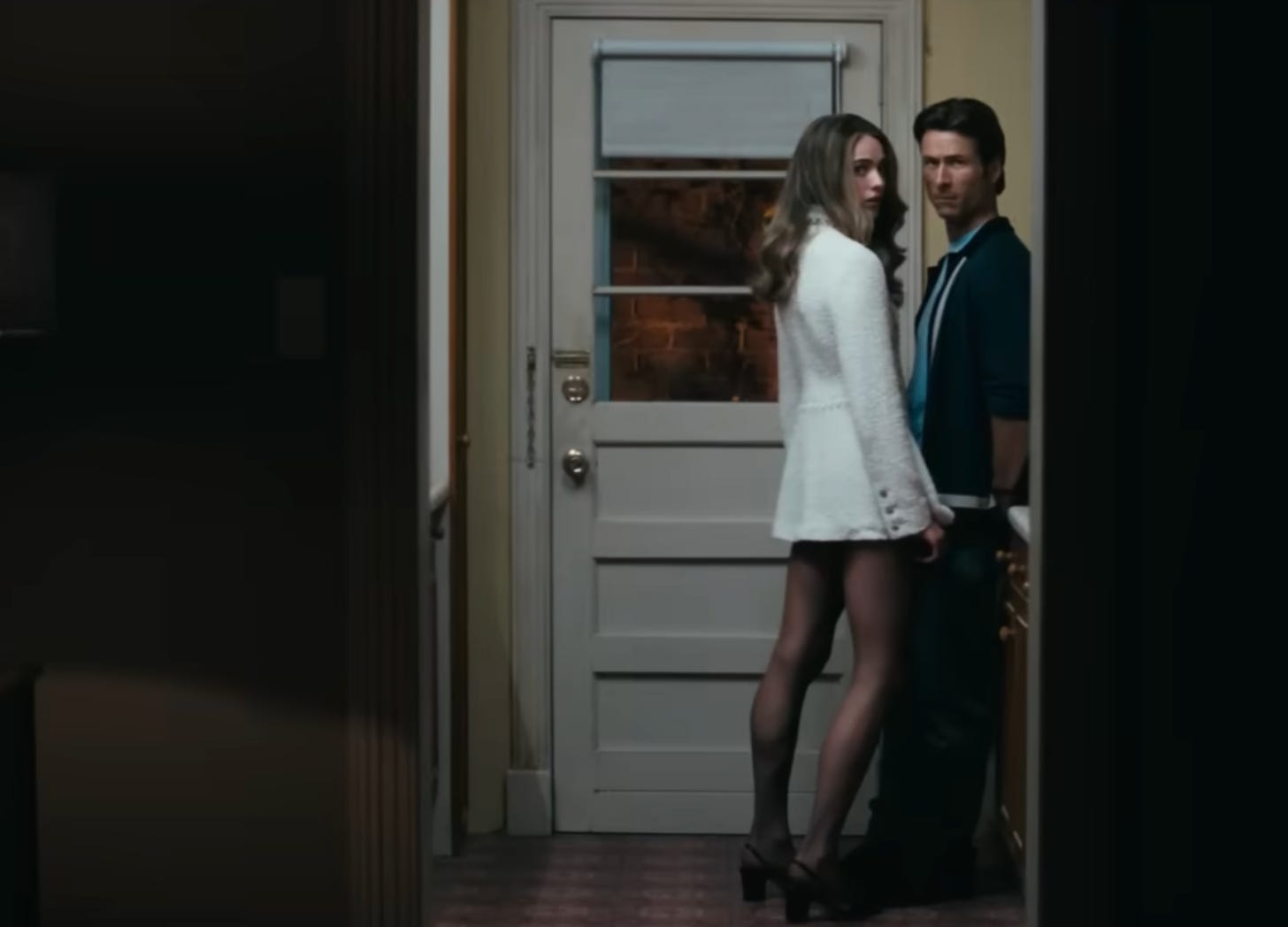
Beckett meets his match in his childhood sweetheart Juli Steinway, played by Margaret Qualley, who catches on to Beckett’s plan and starts blackmailing him. Qualley is somewhat unrealistically extreme in this film. She’s either smiling gleefully, her wide grin accented by her prominent teeth, or looking at Beckett with the most sinister glare. You may think she’s had a psychotic breakdown since you last saw her. She has no middle ground. It’s like she’s suffering multi-personality disorder. Whether that’s deliberate or how Qualley acts all the time is irrelevant. In this film, it’s an advantage to her character. Julie is part femme fatale and part spoilt rich brat. When she tries to blackmail Beckett, she rests her feet up on his desk, giving him and you a full view of her bare legs while flexing her fairly impressive calves. Julie flashes her legs in almost interaction she has with Beckett, even when he’s not physically in the room with her. When they’re talking on the phone, she’s reclined on some seating or another with her legs stretched out. Yet for all her sex appeal, Qualley speaks with a playfully juvenile tone, like her vocal chords haven’t developed much since she was fifteen or maybe younger, and she’s got this excited glimmer in her face when blackmailing Beckett. She looks like the cruel little girl delighted at seeing some bug she’s caught scurry at the bottom of her jar. Qualley looks and talks like the ruthless social predator Beckett isn’t. You get the sense that by the film’s end, she’ll have eaten him alive.
Powell and Qualley make a devastating combination that’s ultimately the most memorable part of the film. How to Make a Killing is worth seeing for them but not much else. This is very much an actors’ film rather than a directors’ film.