
Hollow Knights
An uneven contemporary action thriller about the fall of Kabul in 2021.

Grade: B+
13 Days, 13 Nights (original French title 13 Jours, 13 Nuits) is French director Martin Bourboulon’s first contemporary-set action film after his thrilling, two-part adaption of Alexandre Dumas’ The Three Musketeers in 2023. You could therefore excuse Bourboulon’s clumsiness as he steps, stumbling more than once and quite badly, into filming a contemporary tale rather than a historical one. This clumsiness at times obscures your view of the very real, heroic story Bourboulon takes an honest if uneven stab at turning into a film as gripping his Three Musketeers films.
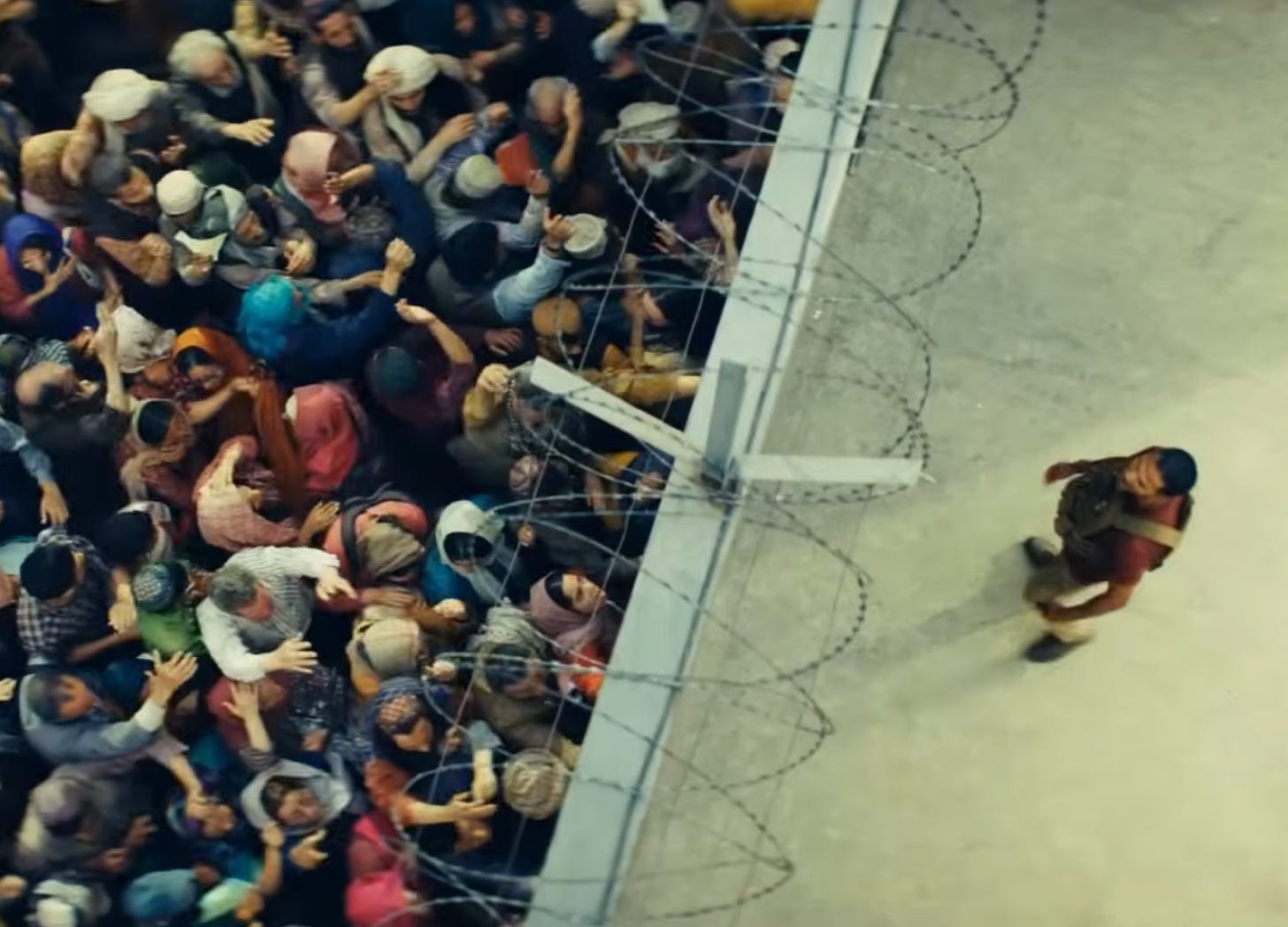
A wise man once said that “Heroes are only people who have run out of choices.”[1] 13 Days, 13 Nights takes place during the Fall of Kabul in 2021. The Afghan capital is in chaos. The victorious Taliban have overrun the city and foreign governments are scrambling to evacuate their personnel and citizens. Commandant Mohamed ‘Mo’ Bida, played by Roschdy Zem, of the DGSE (Direction générale de la Sécurité extérieure - Directorate General for External Security – France’s MI6), supervises the evacuation of French staff and citizens from Kabul’s French embassy. He allows Afghan civilians to seek shelter in the embassy. Amongst them is Franco-Afghan humanitarian worker Eva, played by Lyna Khoudri (who played Constance in Bourboulon’s Three Musketeer films), her mother Amina (Fatima Adoum), and a British journalist named Kate (Sidse Babett Knudsen). Mo and his team are offered a ride out of Kabul but they stay to evacuate everyone inside the embassy. With Eva’s help, Mo enters delicate negotiations with the Taliban to permit him to evacuate everyone. One wrong move on either side, and they could all die. Mo could leave and save himself but that would involve abandoning the civilians to the Taliban. With the benefit of history, you know what that means. Since 2021, Afghans, particularly women and girls, have lost their rights to freedom of speech, assembly and religion, endured torture and extra-judicial killings. Eva, unlike Mo, isn’t a soldier or a spy, but if she doesn’t get out, she and her mother will be left trapped in the hellscape the Taliban will bring to Afghanistan. Mo and Eva have both run out of options and they must take increasingly dangerous, and therefore brave, actions to save themselves and others from the Taliban. They have run out of choices, so they become heroes.
When you look deeper into Mo and Eva however, their characterisations become thinner and almost narrow into oblivion. Bourboulon wrote the film’s script, based on the real Mo’s memoir, with Alexandre Smia and Trân-Minh Nam. The three script writers don’t develop Mo and Eva’s motives beyond a flat, auto-pilot humanitarianism. They never stop Mo or Eva amidst the action, tap them on the shoulder, look them in the eye and ask “Why are you doing this?” They haven’t successfully combined high-stakes action with in-depth characterisation like Christopher Nolan, Michael Mann or David Fincher. There are scenes of Mo saving an old contact from the Taliban and calling his wife and telling her he loves her. There’s a scene where Eva hugs her mother because they can’t go home to get Amina’s wedding ring. Presumably, from these heart-warming snippets Bourbolon, Smia and Nam expect us to conclude that Mo and Eva are just nice people and nice people will, of course, stare down the barrel of an army of trigger-happy, homicidal jihadists for complete strangers.
Zem and Khoudri play their parts well. Zem plays Bida with a clean, action-hero decisiveness. It’s not loudly rugged like John Wayne but the more laconic dynamism of Steve MacQueen in Bullitt and Tom Cruise in Mission: Impossible. He just does what he has to do. Khoudri acts with a beautiful delicacy that makes her terror seem very real and therefore her bravery too. The difference in their ages throws Mo’s seasoned strength into greater relief while simultaneously doing the same for Eva’s young vulnerability. But their poorly elaborated characters mean that they look like automated heroes, like what you’d see in cliched action movies. The type of movie heroes who just do what the writers need the hero to do because they need a hero for their script not because the characters have some motive of their own driving them to be heroic. Mo and Eva are ultimately hollow knights: all armour but nothing inside.
Nicolas Bolduc did the cinematography for the film and he deploys his stark and beautifully harsh, Ridley Scott-esque cinematography, which he used for Bourboulon’s Three Musketeers films and The Count of Monte Cristo. Like on those films, Bolduc used Panavision cameras. He says these cameras give the film “plenty of sharpness, but skin tones retain a certain softness.” Bolduc brings a granular clarity to the texture of the people and the place in the film. He captures Kabul in 2021 as a city built of hot and dusty stone walls.
He gets a bright and raw starkness from the colours of the buildings and the sunlight that’s reminiscent of the harshly scorching glow in Lawrence of Arabia and Denis Villeneuze’s Dune films. The city is searingly monochromic, yet also rich in gradients of visual detail in everything from the cracks in the buildings to the threads in peoples’ clothing and even the wrinkles in their faces. You feel you could reach out and touch this city but then be burned by it. Bolduc shoots Kabul as both historical inferno and human tapestry.
13 Days, 13 Nights manages to be thrilling, but this is down to the acting, Zem and Khoudri’s in particular, and Bolduc’s cinematography more than the writing. Bourbolon, Smia and Nam may have thought history could do much of the work in establishing their story’s stakes. They may have thought that our knowledge about what the Taliban have done to Afghanistan since 2021 would be enough to make a gripping, historical action thriller and that they could get away with superficial characterisation. They were wrong, and they are fortunate that Zam and Khoudri know how to sweat, grimace, smile and cry with every ounce of themselves and that Bolduc knows how to film it all in visceral detail. They do the heavy lifting the film’s director and writers left to history but that history isn’t able to bear.
[1] Chiaki Sekiguchi, quoted by Jake Adelstein in his memoir Tokyo Vice.