
Echoing Guns
If you’re watching Battleship Potemkin, you’ve likely already read about it.

Grade: A-
Watching Battleship Potemkin is more an intellectual experience than an emotional one. Sergei Eisenstein’s 1925 historical epic suffers much the same fate as other silent films in the eyes of the 21st century cinephile who has come to ‘know’ the film extensively through scholarship before even watching it and who has become conditioned to experience films primarily if not exclusively as talkies. It is experienced more as an artefact than a pulsating, visceral alternate reality inside the screen. Yet, today’s film scholars can still derive excitement if they concentrate very hard on observing the film and looking for what they have already read it contains.
If you’re watching Battleship Potemkin, you’ve likely already read about it. You’re likely watching it because you read about it in film school and how Eisenstein pioneered the art of the cut. Eisenstein made the film as propaganda for the new Soviet government in Russia. The film chronicles a mutiny aboard the Battleship Potemkin, a battleship in the Imperial Russian Navy, during the 1905 Russian Revolution. However, Eisenstein also made it to test the theories of montage that he and other Russian filmmakers and theorists had been developing. One was Lev Kuloshov. Kuloshov found that shots could create meaning through how they’re put together, which shot you put after another, in film editing that’s called cutting, not just through what’s inside each individual shot. Shot of man staring at the camera - cut – shot of woman in coffin = the man looks like a sad widower in mourning. However: shot of man staring at the camera – cut – bikini-clad blonde sunbathing by the pool = the man is a lecherous creep. You get the idea. In Battleship Potemkin, Eisenstein put Kuloshov’s theory into practice, and his application would influence filmmakers from Hitchcock to Kubrick. Battleship Potemkin is famous as the film that showed filmmakers that film could be a sequential art, where meaning is created by the images’ sequence, rather than just pictorial art, where meaning comes through the image itself.
The film suffers from the artifice most silent films do when viewed over a hundred years since talkies were invented. That the characters don’t speak creates an affective barrier between you and the reality the film is trying to create. The characters do not look completely real because they do not speak. In true Marxist fashion, Eisenstein’s characters are defined entirely by their role in the political drama. Despite the names attached to them by the title cards that substituted for dialogue in the silent film era, the heroic mutiny leader Grigory Vakulinchuk has no wife or friends or mortal enemies, only his proletariat brothers and his ruling-class antagonists in the class war. He is just the soldier who dies for a loaf of bread. There is no why he died for a loaf of bread or little ones he may have given said loaf of bread to.
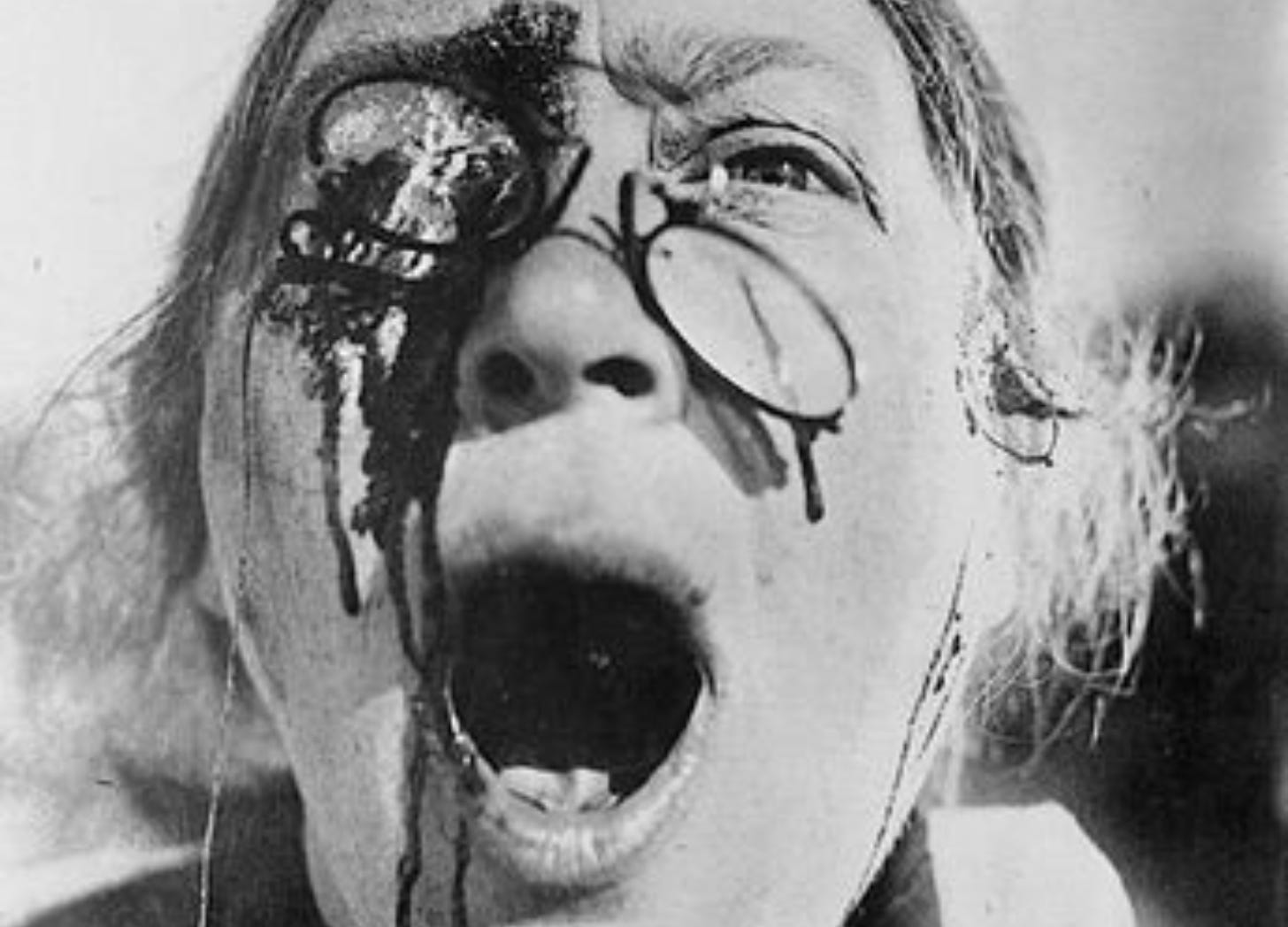
Yet, despite this, some of the characters leap out at you. It’s more to do with Eisenstein’s choice of shocking and unique imagery rather than the writing or the acting. The acting is average silent film pantomime-type acting where all the actors had to do was gesture at emotions with extreme mannerisms, at time appearing like androids performing kabuki. The old woman with her face slashed open by a Cossack’s sabre, her glasses eschew and her mouth gapping open in agony and horror. The child whose hand is crushed under a trooper’s boot. The baby carriage rolling down the Odessa steps as gunfire pierces the stone steps around it. All these will remain burnt into your mind due to their sheer dramatic power.
You will get the most enjoyment out of Battleship Potemkin if you focus on the shots. Do not just sit back and try and sink into the film. You can’t enjoy Battleship Potemkin like that. You must be turned on. You must be analytical. That’s ironic. Much Marxist art, like Bertolt Brecht’s Epic Theatre, aimed to make the audience focus on the art intellectually rather than be soothed and lulled into passive enjoyment by an exciting and believable story. Although, the purpose was to stimulate political consciousness rather than scholarly interest. Watch Battleship Potemkin and think about what happens when Eisenstein shows you one shot after another. Lion statue asleep – cut – lion statue rising startled = what? Watch the shots collide like cannonballs and then fuse together in your minds to synthesise one new thought after another and hear the intellectual cascade unfurl note by note like a symphony.
Battleship Potemkin is hard to enjoy as pure film, but it can be enjoyed as film history.