
A Curious Man
Alan J. Pakula’s sense of looking is more innocent than Hitchcock’s.

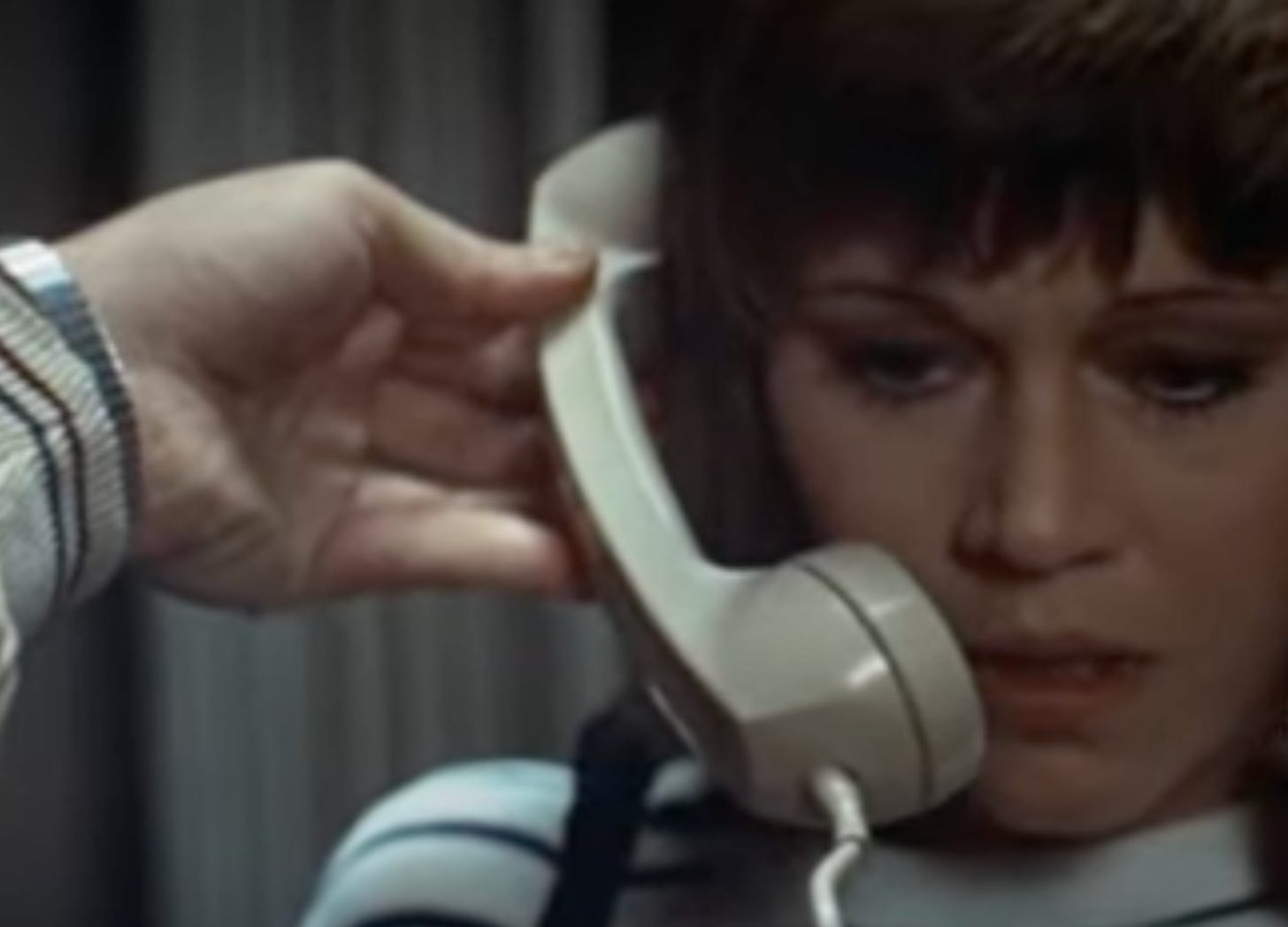
Grade: B+
Alan J. Pakula may be the only filmmaker other than Hitchcock to turn the act of looking into a whole cinematic style, although Pakula’s is more curious than scopophilic.
His 1971 psychological thriller Klute is shot mostly from street corners and across rooms. Donald Sutherland plays policeman John Klute who’s gone to New York to find his missing best friend. His friend may have led a double life as a sexually depraved stalker of prostitutes. To find the truth, Klute teams up with call girl Bree Daniels, played by Jane Fonda.
The film has an eeriness. There’s a sense that there’s something hidden, something dark and slimy that doesn’t want to be uncovered. A respectable man is found to be sending “obscene” letters to a prostitute, but the cops refuse to reveal the letters’ exact contents, even to the man’s wife (or rather especially the man’s wife). Pakula cuts to scenes of a man with his face hidden in shadows listening to a tape recorder from which comes the secretly captured, purring voice of a Daniels saying the only way we can ever be free is to let everything inside us just hang out. “Just fuck it,” she says and her casual yet seductive voice is a siren call to every buried desire to step forward and unleash itself.
You see Klute, Daniels and the other characters from a distance as a bystander would. You’re watching them, like some stalker. There is an actual stalker in this film and at times the camera’s eyes and your eyes become his, but the change in position from where you’re seeing the film is so slight that it’s almost unnoticeable. That’s one flaw in Pakula’s approach. He shoots so consistently from some faceless onlooker’s POV that when you’re actually seeing what’s happening from the creepy killer inside the film, the change in perspective doesn’t scream at you the same way it did in Pyscho when Hitchcock cut the shot and suddenly put you inside Norman Bates’s head as he watched Marion Crane undress.
Pakula’s sense of looking is more innocent than Hitchcock’s. There’s not the perverse glee to it. He never looks at his characters like they’re bugs caught in his killing jar. He looks on them with a penetrating curiosity rather than voyeurism. It’s the gaze of an investigative journalist or a probing psychologist rather than a peeping tom. It’s Woodward and Bernstein’s gaze rather than Norman Bates’s. Klute therefore comes across as more contemplative and heartfelt and less spiky than Psycho or Vertigo or North By Northwest.
Pakula’s film doesn’t jab you with the same thrill as Hitchcock, but you don’t mind it. At some point in the film, the sexually-deranged, psychopath mystery falls into the background. You become more interested in how Klute, this man who’s so honest he at times seems almost school-boyish (which Sutherland helps with his adorable, geekily straight-faced demeanour), will take it if he finds out his best friend is a Norman bates-type. You watch to see if Daniels stops dismissing him as a “square” and falls for him. When will Fonda’s well-groomed combativeness, like a silkily-coated cat with a forever-arched back, relax and let the tenderness that lurks fearfully in her eyes take over? You become interested in them as people and their chances for growth, redemption and happiness as Pakula seems to be as he keeps watching then, rather than as deviants or the victims of some wicked joke as Hitchcock would likely have looked at them.